
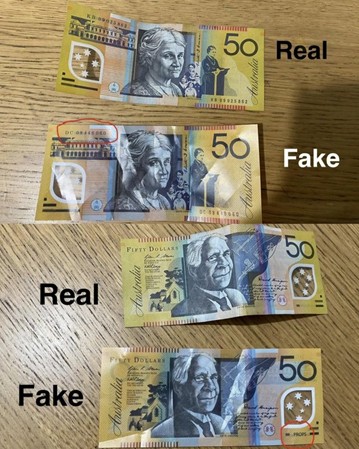
There has recently been a rise in counterfeit cash circulating throughout northeast Queensland, with a number of incidents in Mackay.
Police in Mackay have stated that counterfeit $50 notes have been found at restaurants, shops, and service stations.
Police said some of the recent notes are of “very good quality”, making them difficult to detect.
How to spot fake cash
Some tips from the Reserve Bank of Australia in spotting counterfeit cash include feeling the texture of the note and holding to a light to check for security features. Recent counterfeit bills have been noted as feeling ‘thicker’ than real notes.
Offenders often use counterfeit $50 or $100 notes to make small purchases, aiming to get legitimate currency as change.
The Reserve Bank of Australia provides a counterfeit detection guide located here: https://banknotes.rba.gov.au/counterfeit-detection/counterfeit-detection-guide/
Effects
Passing off counterfeit currency can have a negative impact on communities where it takes place.
Business are not the only entity effected; customers may be at risk of receiving counterfeit currency as change when shopping at an effected business.
Tan Minh Phan, a Queensland owner of a fish and chip shop, stated to Yahoo Finance that, “You lost the money, you lost the food and you don’t know how much change you’ve given to them”, showcasing the significant effect that fake notes can have on business owners.
Criminal Liability for Using Counterfeit Currency
People who possess or produce counterfeit can face a number of charges:
- Possessing Counterfeit Money: Under Section 9 of the Crimes (Currency) Act 1981 (Cth), it is an offence to possess counterfeit money knowing it is fake. The maximum penalty is 10 years imprisonment for individuals.
- Circulating Counterfeit Cash (Uttering): Under Section 7 of the Crimes (Currency) Act 1981, passing or using fake money (uttering) knowing it to be counterfeit carries a maximum penalty of 12 years imprisonment.
- Making Counterfeit Money: Producing fake currency under Section 6 of the Act carries a maximum penalty of 14 years imprisonment.
- Fraudulent Transactions (Qld Criminal Code): Using counterfeit cash to purchase goods constitutes fraud under Section 408C of the Criminal Code 1899 (Qld).
- General Fraud: Maximum 5 years imprisonment.
- Aggravated Fraud: If the fraud involves over $30,000, or if the offender is an employee or director of a business, the penalty can increase to 14–20 years imprisonment.
Our team are experts in criminal law. Our role is to sit down with you and work out the strategy that will get you the best possible result. If you have any questions about this article or any other topic of law, please call our team of experts on 1300 066 669.